
The Federal Government has successfully issued a ₦501 billion inaugural bond to settle legacy debts owed to power generation companies (Gencos) under the Presidential Power Sector Debt Reduction Programme (PPSDRP), recording 100 per cent subscription from pension funds, banks and asset managers. The landmark financing move comes amid renewed concerns over grid stability after Nigeria suffered its second power system failure in one week, plunging parts of the country into darkness on Tuesday.
Finance Minister and Coordinating Minister of the Economy, Wale Edun, said the strong investor appetite reflected renewed confidence in ongoing power sector reforms and government’s commitment to restoring liquidity across the electricity value chain.
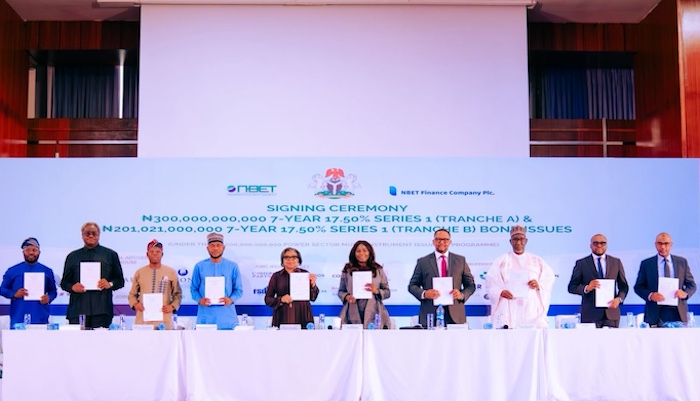
The bond issuance—executed through NBET Finance Company Plc, a special purpose vehicle—forms part of a broader ₦4 trillion Power Sector Multi-Instrument Issuance Programme designed to clear over a decade of unpaid electricity liabilities.
Five power generation companies that opted into the programme have signed Final Settlement Agreements (FSAs) worth ₦827.16 billion, to be paid in four phased instalments.
Nigeria’s power sector has been burdened by unpaid government obligations dating back more than ten years, weakening balance sheets, limiting gas supply, reducing plant availability and discouraging new investment.
According to Edun, resolving these debts was “not optional but essential,” prompting the creation of the PPSDRP under the administration of President Bola Ahmed Tinubu. The programme settles verified receivables for electricity supplied between February 2015 and March 2025 through negotiated agreements financed via domestic capital markets.
How the Bond Works
The seven-year bonds, fully guaranteed by the full faith and credit of the Federal Government, raised ₦300 billion from the capital market, with ₦201 billion allocated directly to participating Gencos.
Proceeds from the Series 1 issuance will fund the first and second instalment payments, estimated at ₦421.42 billion, representing about 50 per cent of the negotiated settlement value. Payments will be made through a mix of cash and promissory notes.
Participating companies include Geregu Power Plc, First Independent Power Limited, Ibom Power Company, Mabon Limited, and the Niger Delta Power Holding Company (NDPHC), covering 14 power plants nationwide.
Government and Industry Reactions
Special Adviser to the President on Energy, Olu Verheijen, described the programme as a “decisive reset” of Nigeria’s electricity market, stressing that it was not a bailout, but a balance-sheet repair aimed at restoring financial credibility.
She said clearing legacy liabilities would improve liquidity, strengthen payment certainty for gas suppliers, and create room for maintenance and new investments.
NBET Acting Managing Director, Johnson Akinnawo, said the bond issuance marked a major breakthrough in resolving long-standing power sector constraints, while Sahara Power Group’s Kola Adesina confirmed that fresh investments—including expansion at Egbin Power Plant—would follow debt resolution.
Impact / What It Means
When completed, the programme will impact 4,483.6MW of generation capacity, settle payments for over 290,644GWh of electricity, and support power supply to more than 12 million registered customers nationwide. Analysts say the initiative strengthens fiscal discipline, restores investor confidence, and lays the foundation for a more reliable electricity market.
Grid Collapse Casts Shadow Over Reforms
Despite the financing milestone, Nigeria’s national grid suffered another system failure at about 10:48am, triggering widespread outages across multiple distribution networks.
While Discos including EKEDC, PHED and AEDC confirmed a total loss of supply, the Nigerian Independent System Operator (NISO) clarified that the incident was a partial system collapse caused by a voltage disturbance originating from the Gombe Transmission Substation, with restoration completed shortly after 11am.
Business Community Raises Alarm
The Lagos Chamber of Commerce and Industry (LCCI) expressed grave concern over the recurrence, warning that repeated grid failures threaten economic recovery, manufacturing output and investor confidence.
LCCI Director-General, Dr. Chinyere Almona, called for an independent forensic audit of the national grid, warning that without urgent reforms Nigeria could experience “tens of grid collapses in 2026” under a business-as-usual scenario.